

Detailed image description
Low-dose computed tomography — detailed image description
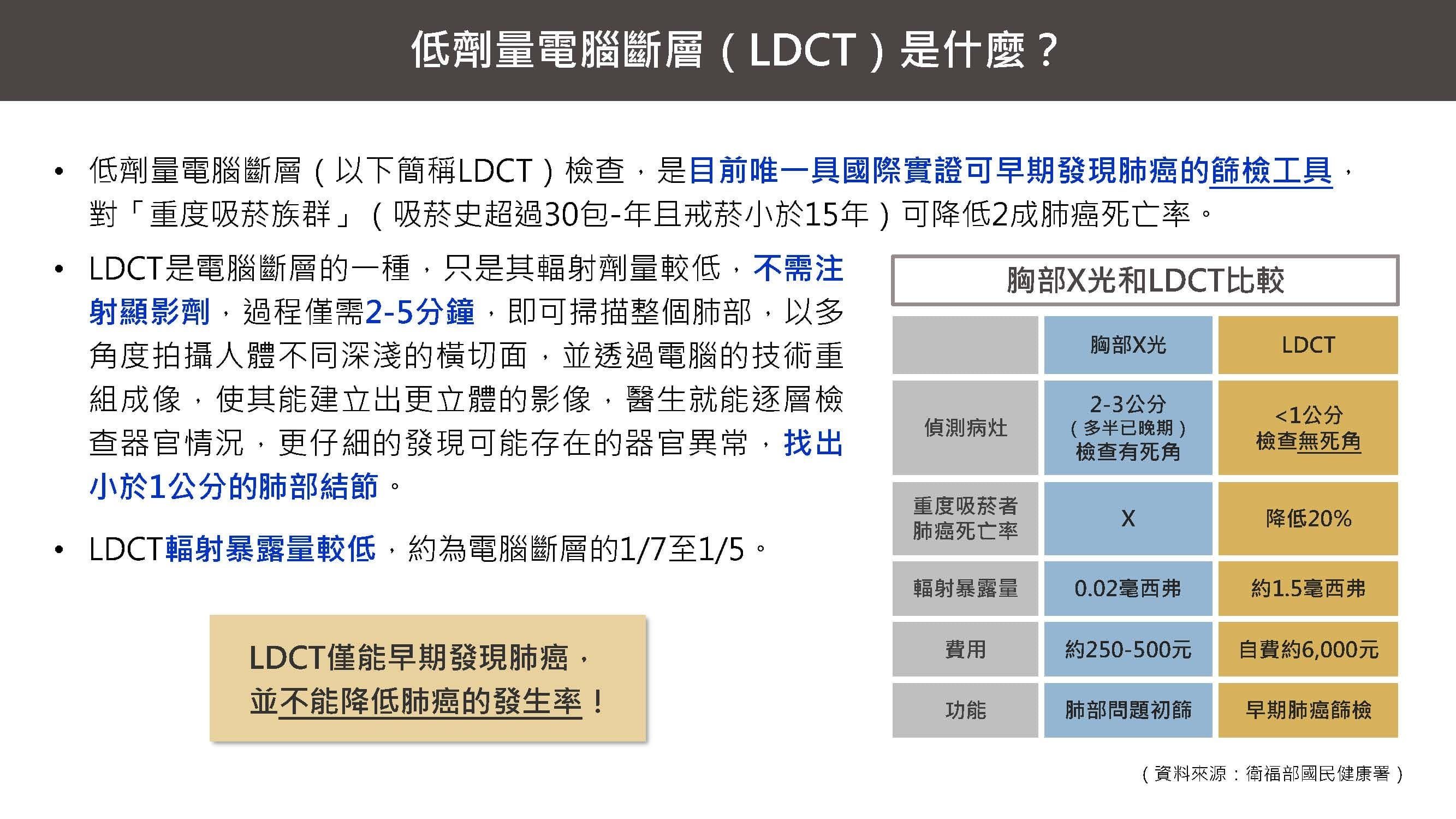
The infographic introduces low-dose computed tomography, its procedure and radiation dose, and compares it with a standard chest X-ray.
Purpose and procedure
- LDCT is the only internationally validated screening tool for detecting lung cancer early. For heavy smokers with more than 30 pack-years who quit less than 15 years ago, it can reduce lung cancer mortality by 20%.
- LDCT is a lower-dose CT scan. It requires no contrast injection and scans the lungs in about two to five minutes. Computer reconstruction creates a three-dimensional view that can reveal nodules smaller than one centimeter.
- Its radiation exposure is about one-seventh to one-fifth of a standard CT scan.
- LDCT can detect lung cancer early, but it does not reduce the incidence of lung cancer.
Chest X-ray and LDCT comparison
Source: Taiwan Health Promotion Administration, Ministry of Health and Welfare.
| Item | Chest X-ray | LDCT |
|---|---|---|
| Lesion detection | About 2–3 cm; overlapping structures may create blind spots | Less than 1 cm; no blind spots |
| Lung cancer mortality in heavy smokers | No demonstrated reduction | 20% reduction |
| Radiation exposure | 0.02 mSv | About 1.5 mSv |
| Cost | About NT$250–500 | About NT$6,000 self-pay |
| Purpose | Initial screening for lung problems | Early lung cancer screening |